


Views: 0 Author: Site Editor Publish Time: 2025-06-19 Origin: Site


In today’s modern industrial landscape, the demand for quiet and high-torque power transmission systems is greater than ever. From conveyor lines in food processing plants to automated lifting systems and packaging machinery, equipment must perform smoothly, reliably, and with minimal noise to meet workplace safety, energy efficiency, and environmental standards.
This is where the helical worm gear comes into play — a powerful gearbox solution that blends the gradual meshing benefits of helical gears with the high-ratio reduction of worm drives. The result? A compact, efficient, and whisper-quiet gearbox ideal for a wide range of applications where noise reduction and torque amplification are mission-critical.
Unlike traditional gear setups, helical worm gear reducers provide smoother operation with lower vibration and better torque transmission at lower speeds. These combined properties make them especially suitable for industries where space is limited, performance is continuous, and operational noise must be minimized.
Understanding the operation of helical gears and worm gears is fundamental to grasping how their combination delivers superior performance in industrial applications.
Helical gears feature teeth that are cut at an angle to the gear’s axis, forming a helix shape. This angled tooth design allows the teeth to engage gradually and smoothly, rather than suddenly as in spur gears. This gradual engagement significantly reduces vibration and noise during operation. Because the load is distributed over multiple teeth at once, helical gears can handle higher torque and operate more quietly and efficiently.
In addition to their smooth motion, helical gears also support higher speeds and can transmit power between parallel or even slightly skewed shafts. This makes them versatile for a wide range of machinery requiring durability and quiet operation.
Worm gears consist of a screw-like shaft called the worm and a mating gear known as the worm wheel. The worm meshes with the worm wheel at a right angle, converting rotational motion between perpendicular shafts. One key advantage of worm gears is their ability to achieve very high gear reduction ratios in a compact space.
The worm’s helical threads "roll" over the worm wheel teeth, allowing for large speed reductions while simultaneously increasing output torque. Moreover, worm gear systems often exhibit self-locking behavior—meaning the worm can drive the gear, but the gear cannot drive the worm—offering inherent safety and load-holding capability in many applications.
The helical worm gear combination ingeniously merges the gradual meshing action of helical gears with the high reduction capability of worm gears, resulting in a transmission system that offers both smooth engagement and significant torque multiplication.
In this combined system, the helical gear's angled teeth engage progressively with the worm gear teeth. Unlike straight-cut gears where the entire tooth profile contacts abruptly, helical teeth mesh gradually along the tooth surface. This gradual, rolling contact minimizes impact forces, reducing vibrations and noise during operation. The multi-tooth contact also distributes load evenly, decreasing wear and increasing the gear set’s lifespan.
The worm gear component acts like a screw driving a gear wheel, allowing for very high gear reduction ratios within a compact size. While the helical gear handles the initial power input smoothly, the worm gear significantly slows the output shaft’s speed while proportionally increasing the torque. This is particularly advantageous for applications requiring high torque at low speeds—such as lifting mechanisms, conveyors, and heavy-duty automation equipment.
By integrating these two gear types, the system achieves:
Quiet and smooth operation, thanks to the helical gear’s gradual tooth engagement.
Compact design with high torque output, enabled by the worm gear’s reduction ratio.
Right-angle shaft arrangement, saving space and simplifying installation in tight environments.
Enhanced load capacity and durability, due to distributed tooth contact and reduced mechanical shocks.
This combination is why helical worm gear reducers are widely favored in industries that demand efficient, reliable, and low-noise power transmission solutions.
One of the standout advantages of the helical worm gear combination is its exceptional ability to reduce operational noise, making it ideal for noise-sensitive industrial environments.
The angled teeth of the helical gear ensure that gear meshing happens gradually rather than abruptly. This progressive engagement smooths out the transfer of power between gears, which significantly reduces sudden shocks and vibrations—primary sources of mechanical noise. The overlapping contact of multiple teeth spreads the load, minimizing stress concentrations that can cause rattling or knocking sounds.
Because the forces are applied more evenly and over a longer period during each rotation, the system experiences fewer mechanical impacts. Reduced impact forces translate into less vibration being transmitted through the gearbox housing and connected machinery. Lower vibration levels also mean that resonance frequencies within the system components are less likely to be excited, further reducing noise emissions.
The robust design of the helical worm gear set adds to its inherent stiffness and stability. This structural integrity helps absorb and dampen vibrations generated during high-torque operations, leading to a quieter running gearbox.
In practical terms, these noise reduction benefits:
Improve worker comfort and safety by lowering ambient noise levels in industrial settings.
Comply with stricter workplace noise regulations.
Enhance the longevity of machinery by reducing wear caused by vibration.
Enable installation in noise-sensitive environments like hospitals, food processing plants, or offices.
By combining shock absorption, gradual meshing, and vibration dampening, the helical worm gear system effectively controls noise, making it a preferred solution where quiet operation is just as critical as power transmission.
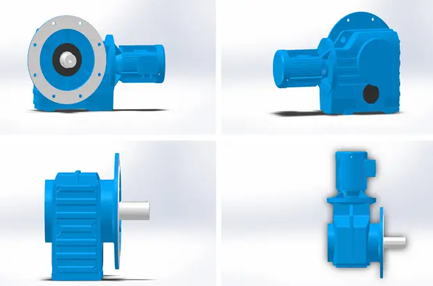
One of the most significant benefits of the helical worm gear combination is its ability to dramatically increase output torque within a compact design. This makes it an ideal choice for applications where space is limited but high torque is essential.
The worm gear mechanism operates much like a screw driving a gear wheel, which inherently provides very high gear reduction ratios. By converting high-speed, low-torque input into low-speed, high-torque output, the system multiplies the torque several folds without requiring bulky or complex additional components.
Meanwhile, the helical gear’s gradual tooth engagement ensures that this torque increase is delivered smoothly and consistently, reducing mechanical stress and enhancing reliability. The multi-tooth contact also distributes the load evenly, preventing premature wear and maintaining optimal performance over extended use.
This combination allows engineers to design compact, lightweight gearboxes that do not compromise on power, making them highly efficient and cost-effective.
The torque amplification and noise reduction features of helical worm gearboxes make them indispensable across many industrial sectors, especially in high-load and precision-driven equipment.
Smooth, high-torque output is critical for safely moving heavy loads while ensuring quiet operation—both essential in residential and commercial buildings.
Machines such as mixers, conveyors, and packaging lines require reliable torque to maintain steady processing speeds, often in clean or noise-sensitive environments.
Continuous operation with minimal vibration and noise is vital for efficiency and worker safety on production lines and in logistics centers.
Precision and quiet performance enable consistent fabric handling and print quality, where vibration could cause defects.
Devices like sludge dewatering presses and aerators rely on high torque to operate under heavy load conditions while minimizing noise pollution.
The combination of helical and worm gears offers a uniquely effective solution for industrial power transmission, blending smooth, quiet operation with high torque amplification in a compact package. By leveraging the gradual tooth engagement of helical gears alongside the high reduction ratios of worm gears, this technology significantly reduces noise and vibration while delivering the torque needed for demanding applications.
From elevators and conveyor systems to food processing and environmental equipment, helical worm gearboxes provide reliable, efficient, and durable performance that meets the rigorous needs of modern industry. Their ability to operate quietly and handle heavy loads makes them indispensable in both traditional and noise-sensitive environments.
For companies seeking advanced gear solutions, Shanghai Taixing Transmission Technology Co., LTD offers high-quality helical worm gear products designed to optimize noise control and torque output. To learn more about their innovative gearboxes and how they can improve your machinery’s performance, visit www.shtaixingreducer.com or contact their expert team today.


